Parquet and Wooden Flooring Price in Dubai, Installed
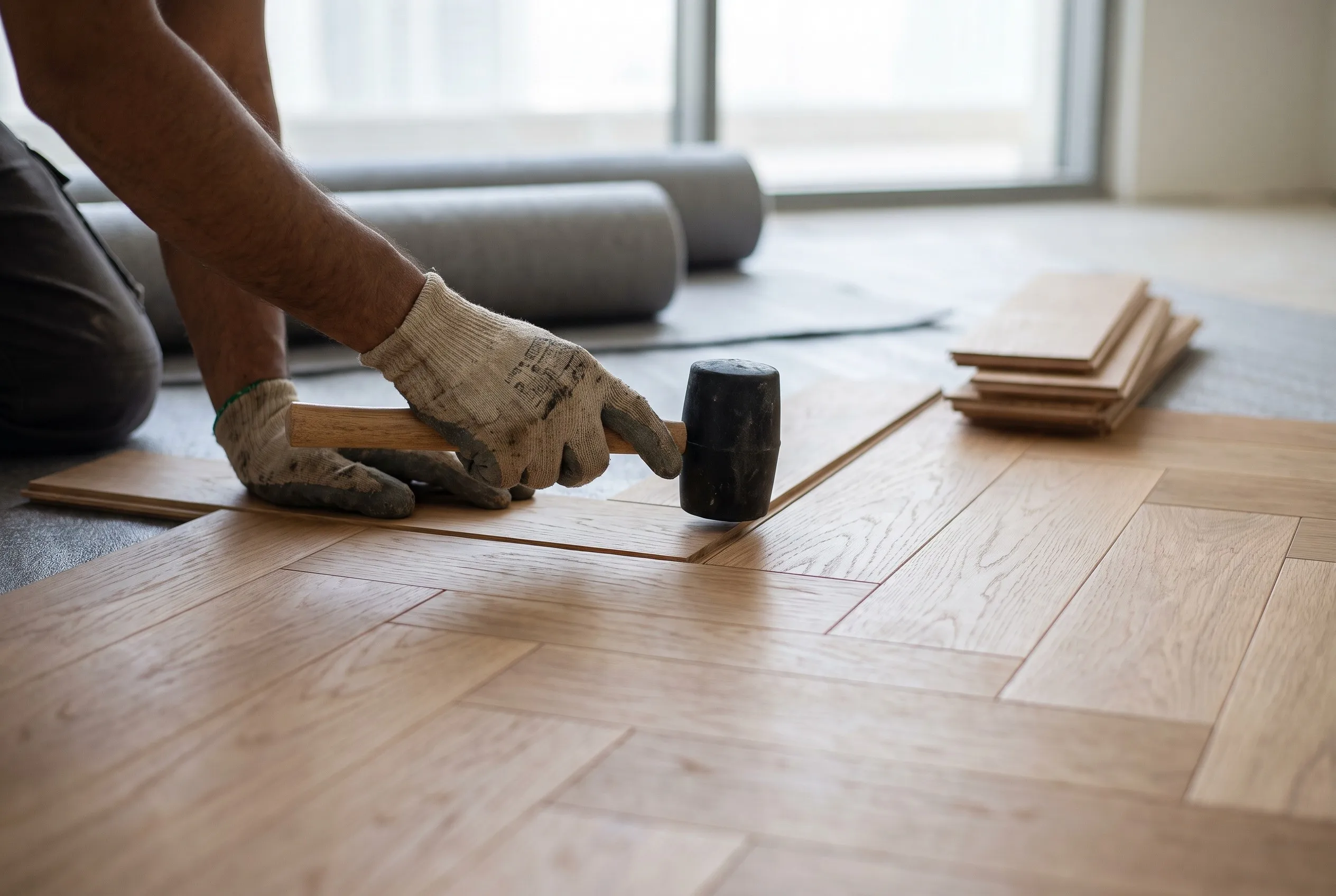
As a rough guide in 2026, wood flooring material in Dubai is typically quoted at AED 100–250 per sq m for engineered wood and AED 150–300 per sq m for solid parquet. That is the material only. The installed price also includes subfloor preparation, underlay, labour, skirting and finishing, and it depends on the room, the pattern and the condition of your floor.
We do not publish a single installed rate. We have found no reliable Dubai figure for the installed parquet price, so we won't make one up. Below we show what the final number is made of, so you can check any quote line by line. We price your actual floor after a survey.
What the installed price of a wood floor is made of
A quote that says only "AED per sq m, supply and fit" hides most of the decisions. A proper quote separates these items:
- Boards or parquet blocks. Priced per sq m. Add 5–10% for cutting waste on straight lays, and more for herringbone or chevron, where more offcuts are lost.
- Removal of the old floor. Old tile has to be broken out and carted away. A floating floor over sound tile sometimes avoids this.
- Subfloor levelling. Wood needs a flat, dry base. A screed that is out of level or still holding moisture is the usual cause of later gaps and lifting.
- Underlay and moisture barrier. Needed for floating and glued systems. The type depends on the board.
- Labour. A herringbone floor takes noticeably longer than planks laid in a straight run.
- Skirting, thresholds and finishing. Solid parquet is sanded and sealed on site. Engineered boards usually come pre-finished.
- VAT. Fit-out services carry 5% VAT on the contractor's invoice.
Typical price ranges quoted in Dubai in 2026
The table puts wood next to other common floors, so you can see where it sits. Most of the ranges are material prices. The sources do not always say whether a figure is material only or installed, and we flag that below.
| Item | Typical range, AED | What it covers |
|---|---|---|
| Engineered wood | 100–250 per sq m | Material only |
| Solid parquet | 150–300 per sq m | Material only |
| Wood flooring, general range | 150–300 per sq m | Not clear whether material or installed |
| Ceramic tile | 50–150 per sq m | Not clear whether material or installed |
| Porcelain tile supply | 60–180 per sq m | Material only |
| Porcelain tile laying labour | from 50 per sq m | Labour only |
| Marble | 300–700 per sq m | Not clear whether material or installed |
| Permit fees, apartment interior only | 1,500–2,500 in total | Excludes consultant and contractor |
| Owners' association deposit | 2,000–30,000, refundable | Sources conflict, each building sets its own |
Treat the flooring ranges as a starting point. Thickness of the wear layer, wood species, finish and brand move a board well within or outside them. Imported materials can also take 6–12 weeks to ship, which affects when you can start.
Never compare two parquet quotes on the per sq m figure alone. One may include levelling, underlay, skirting and sanding, and the other only the boards and a fitter. Ask for both to be itemised in the same order.
Three typical cases, material cost only
These examples multiply the material ranges above by the floor area. Labour, preparation and VAT come on top, and we price them after measuring.
Living room, 40 sq m (about 430 sq ft)
Engineered wood at AED 100–250 per sq m gives roughly AED 4,000–10,000 for the boards. A straight lay keeps waste low. If the room is currently tiled, removal and levelling can matter as much as the boards.
Apartment, 80 sq m of living and bedrooms (about 860 sq ft)
Solid parquet at AED 150–300 per sq m gives roughly AED 12,000–24,000 for the material. Add the on-site sanding and sealing that solid blocks need, plus an allowance for pattern waste.
Villa ground and first floor, 150 sq m (about 1,615 sq ft)
Engineered wood at AED 100–250 per sq m gives roughly AED 15,000–37,500 for the boards. Large areas make subfloor flatness and moisture checks across the whole slab the main risk to control.
Solid or engineered: which suits a Dubai home
Dubai homes are cooled by air conditioning most of the year, and humidity swings between a dry cooled room and a humid outdoors. Solid wood reacts to those swings by moving. Engineered boards, with a layered core, are generally more stable, which is why they are the more common choice in apartments.
Solid parquet makes sense where you want a floor that can be sanded several times over its life and the room is climate-controlled and stable. If you want the look of wood but expect heavy use, a wood-look porcelain is worth a comparison. We cover that in real wood versus wood-look porcelain in the Dubai climate, and the tile side in porcelain versus ceramic tiles.
Keep wood out of wet areas such as bathrooms, and be careful next to kitchen sinks, balcony doors and dishwashers. Leaks and cleaning water are what damage wood floors first.
How a wood floor installation goes
- Survey and moisture check. We measure each room, check the level of the existing floor and look for damp or hollow areas before any board is chosen.
- Choice of floor and pattern. Species, finish, plank or herringbone. We can show the result on photos of your own rooms before work starts.
- Approvals. Building management or the owners' association must approve the work first. We prepare and submit the documents for the building NOC. See what a NOC is and when you need one.
- Removal and levelling. Old flooring comes out, the base is levelled and the underlay goes down. Furniture, lifts and corridors are protected, and the site is kept clean.
- Laying and finishing. Boards are laid with correct expansion gaps at the walls. Solid parquet is then sanded and sealed. Skirting and thresholds follow.
- Handover. We go through a checklist, clean, and give you a written warranty. You get a photo and video report every day, and clients abroad can accept each stage by video call.
Do the flooring last among the dirty trades, after plastering, ceilings and painting, so it is not damaged. Our guide to how long a home renovation takes in Dubai shows where flooring fits in the sequence.
What pushes the price up or down
- Pattern. Herringbone and chevron cost more in labour and waste than planks.
- Condition of the base. Uneven or damp screed adds levelling work. This is the most common surprise.
- Removal of old tile. Breaking out tile adds labour and waste removal.
- Area and layout. Many small rooms and doorways cost more per sq m than one open floor.
- Building rules. Noisy work hours and deposits are set by each building, so they affect scheduling. See renovation working hours and building rules in Dubai.
For the wider budget, including how flooring sits within a full job, read how much it costs to renovate an apartment in Dubai and see our pricing page.
Budget for the boards using the ranges above, then add preparation, labour, skirting, finishing and 5% VAT. Choose engineered wood for most apartments and keep solid parquet for stable, dry rooms. Ask every contractor for an itemised quote, and make sure it includes levelling.
Get your wood floor priced line by line
We visit, measure, check the base and send an itemised quote. The price and timeline are fixed in the contract, with no extras beyond the quote.
Book a site surveyFAQ
How much does parquet flooring cost in Dubai?
As a rough guide in 2026, the material is typically AED 100–250 per sq m for engineered wood and AED 150–300 per sq m for solid parquet. The installed price adds preparation, labour, underlay, skirting and 5% VAT, so it depends on your floor. We give an itemised figure after a survey.
Is engineered or solid wood better for a Dubai apartment?
Engineered wood is generally more stable when air conditioning and humidity change, so it suits most apartments. Solid parquet suits stable, climate-controlled rooms where you want the option to sand the floor several times.
Do I need approval before installing wood flooring in an apartment?
Usually yes. Building management or the owners' association generally has to approve the work, and it may ask for a deposit. We prepare and submit the documents for the building NOC, and you should confirm the exact rules with your building.
Can wood flooring go in a bathroom or kitchen?
We advise against it in bathrooms and around sinks and balcony doors, because water is the main thing that damages wood. For wet areas a porcelain tile is the safer choice, and wood-look porcelain gives a similar appearance.