Membrane, Polyurea or Cementitious Waterproofing in Dubai
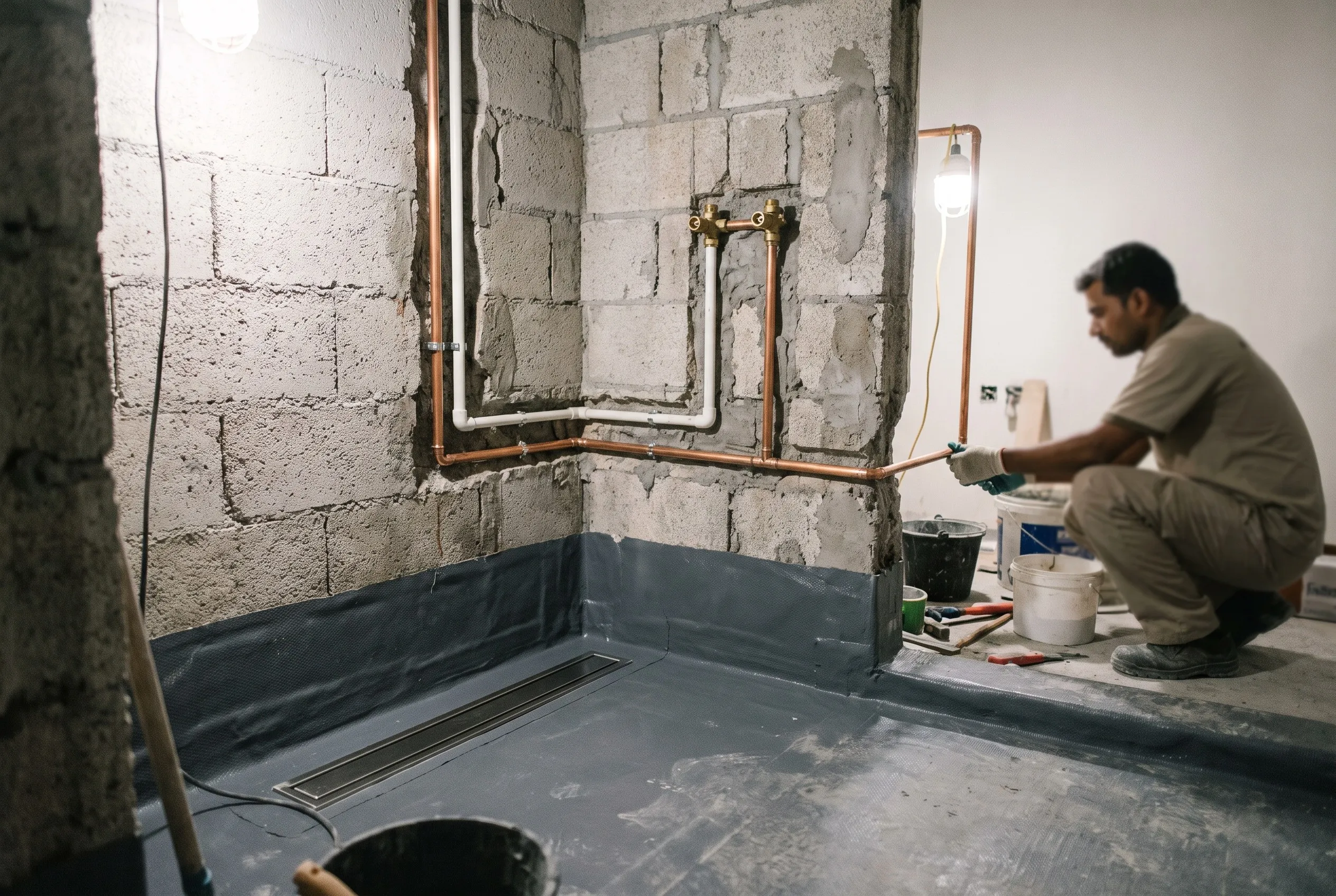
For most Dubai bathrooms, the safest approach is a combination: a cementitious coat over the whole wet area, with a flexible liquid membrane and reinforcing tape in the corners, around the drain and at the pipe penetrations. Polyurea and sheet membranes suit specific cases, such as terraces, planters, or a shower base that has to be completed quickly. The system matters less than the detailing and the test, and every system needs a flood test before tile.
Below we compare the four options on the criteria that decide whether a bathroom stays dry for years, and say when each one fits.
What a waterproofing system has to do in a Dubai bathroom
A bathroom floor and shower walls are in contact with water every day. In Dubai the conditions are harder than the average. Apartments are air-conditioned to a cool temperature while the outside is hot and humid, so condensation and moisture movement are constant. Slabs also move slightly with temperature. A coating that is hard and brittle can crack along those movements, and a crack under tile is invisible until the ceiling below is stained.
So we judge every system on five things: adhesion to the substrate, flexibility (can it bridge a hairline crack), behaviour at corners and penetrations, how long it needs to cure before a test, and how the tile adhesive bonds to it. The coating itself is rarely the point of failure. Most leaks start at the floor drain, the wall-to-floor junction or a pipe that passes through the slab.
The four systems side by side
| Criterion | Cementitious coating | Liquid membrane (polyurethane / acrylic) | Sheet membrane | Polyurea |
|---|---|---|---|---|
| Form | Mineral slurry, brushed or rolled in coats | Liquid applied by roller or brush, cures to a rubbery film | Pre-formed sheet bonded to the substrate | Sprayed or poured elastomer, very fast curing |
| Flexibility | Low to moderate; flexible grades exist | High | High, consistent thickness | Very high |
| Corners and pipes | Needs reinforcing tape and care | Easy to detail with tape and collars | Needs prefabricated corners and seals | Seamless, but needs a clean, prepared surface |
| Tile bonding | Excellent, mineral to mineral | Good with the correct adhesive | Good on the right sheet face | Needs a specified primer or bonding layer |
| Cure time before test | Follow the product datasheet | Follow the product datasheet | Short once bonded and sealed | Short |
| Skill needed | Moderate | Moderate | High at the details | Specialist applicator and equipment |
| Typical use | Floors and shower walls | Corners, junctions, whole bathroom | Shower trays, showers on tight schedules | Terraces, roofs, planters, some wet rooms |
Cure times vary a great deal between products. One manufacturer asks for 48 to 72 hours before a flood test, another for a couple of hours at 21°C or above. That is why we follow the datasheet for the specific product on site and do not work to a generic number.
When each system makes sense
Cementitious
A cementitious coat is the workhorse for a standard apartment bathroom. It bonds well to the screed and walls, tile adhesive grips it well, and it is forgiving of damp surfaces. Use a flexible grade, apply it in at least two coats and do not rely on it at the corners. On its own, a rigid cementitious coat is the weakest option where there is movement.
Liquid membrane
A liquid membrane is the best way to handle details. It follows awkward shapes around the drain, the niche and the door threshold, and it stays elastic. It can be used over the whole area, but the film must reach a consistent thickness, and a thin spot is only found by testing. It also depends on the tile adhesive being compatible, so the adhesive and the membrane should come from the same system or be confirmed as compatible.
Sheet membrane
A sheet gives a predictable thickness because it is made in a factory. It is useful when the schedule is tight, or in showers where the sheet system includes a pre-formed tray, drain and corners. Its weakness is the joints and the seal around the drain. It rewards a careful installer and punishes a hurried one.
Polyurea
Polyurea is very strong and elastic and cures quickly. It is a good choice for terraces, balconies, planters and roofs, where there is UV, heat and standing water. In an interior bathroom it is often more than the job needs, and tile adhesive will not bond to it without the right primer or bonding layer. For a villa roof, see our guide to villa roof waterproofing in Dubai.
Combination
A combination uses a cementitious coat over the large flat areas and a liquid membrane with reinforcing tape in the corners, the wall-to-floor junctions, around the drain and at pipe penetrations. It gives the good tile bond of a mineral coat and the flexibility of a membrane exactly where cracks begin. This is what we would choose for most apartment bathrooms and wet rooms in Dubai.
The system is only half of waterproofing. The drain flange, the corner tape, the pipe seals and the height the membrane climbs up the walls decide whether it leaks. A good product with poor detailing fails earlier than an ordinary product with careful detailing, so ask how the corners and the drain are handled, not only what is on the label.
How the work should go, whichever system you choose
- Prepare the substrate The screed and walls are cleaned, levelled and primed as the product requires. Dust and loose material cause most adhesion failures.
- Detail first Corners, junctions, the drain and pipe collars are sealed and reinforced before the main coats go on.
- Apply the coats The membrane is applied in the specified number of coats, each allowed to cure as the datasheet states, and carried up the walls to the height the design requires.
- Photograph before covering Pipes, cables and waterproofing are photographed before they disappear under tile, so there is a record of what is behind the finish.
- Flood-test for 24 hours The area is filled with water and left. A common test standard calls for 24 to 72 hours, and no tile goes down until the level holds. We test for 24 hours, after the product has cured.
- Tile to a layout Tiles go down only after a pass, using a planned layout and a laser level. See the full sequence in our bathroom renovation stages.
Choosing for your property
The right choice depends on the room and the building, not on a fashionable material.
- Apartment bathroom with a new floor: combination, cementitious over the area, liquid membrane at details.
- Walk-in shower with a low or flush tray: a liquid or sheet membrane system, with careful drain detailing. See walk-in shower design for depth and drainage.
- Terrace, balcony or roof: polyurea or a UV-stable membrane, which the roof guide covers.
- Older villa with a cracked slab: a flexible liquid membrane or sheet over the entire floor, after the cracks are repaired.
In an apartment, remember that a leak affects the neighbour below. Many buildings ask for method statements and insurance as part of the NOC, so your waterproofing plan is worth having in writing. Our guide to the renovation permit and NOC explains what the building usually asks for. For what it costs and why it should not be cut, see bathroom waterproofing cost.
For most Dubai bathrooms, choose a combination: cementitious coat on the surfaces and a flexible liquid membrane with tape on every corner, junction and penetration. Use polyurea for terraces and roofs, and sheet systems where a pre-formed shower base suits the design. Whatever you pick, insist on photographs of the hidden work and a 24-hour flood test before any tile is laid.
Not sure which waterproofing your bathroom needs?
We visit, measure, check the substrate and the drain position, and recommend a system in an itemised quote with the price and timeline fixed in the contract. You can see how we work on our process page and what we do on the bathroom renovation page.
Book a site surveyFAQ
Is polyurea better than a cementitious coating for a bathroom?
Not automatically. Polyurea is very elastic and fast, which suits terraces and roofs, but tile adhesive does not bond to it without a specified primer or bonding layer. For a normal bathroom a cementitious coat with a flexible membrane at the details is usually the better fit.
What is a combination waterproofing system?
It uses a cementitious coating on the large flat surfaces and a liquid membrane with reinforcing tape at the corners, junctions, drain and pipe penetrations. It combines a strong tile bond with flexibility where cracks tend to begin.
How long should a flood test last before tiling?
Test standards describe 24 to 72 hours of standing water, and manufacturers set their own cure time before a test. We flood-test wet areas for 24 hours before any tile goes down, after the product has cured per its datasheet.
Can I waterproof only the shower area and not the whole bathroom floor?
It is safer to waterproof the entire wet floor and carry the membrane up the walls, because water travels under tile. In an apartment, a leak also reaches the neighbour below, so partial waterproofing is a poor place to save.