Marble Flooring in Dubai: Good or Bad Choice?
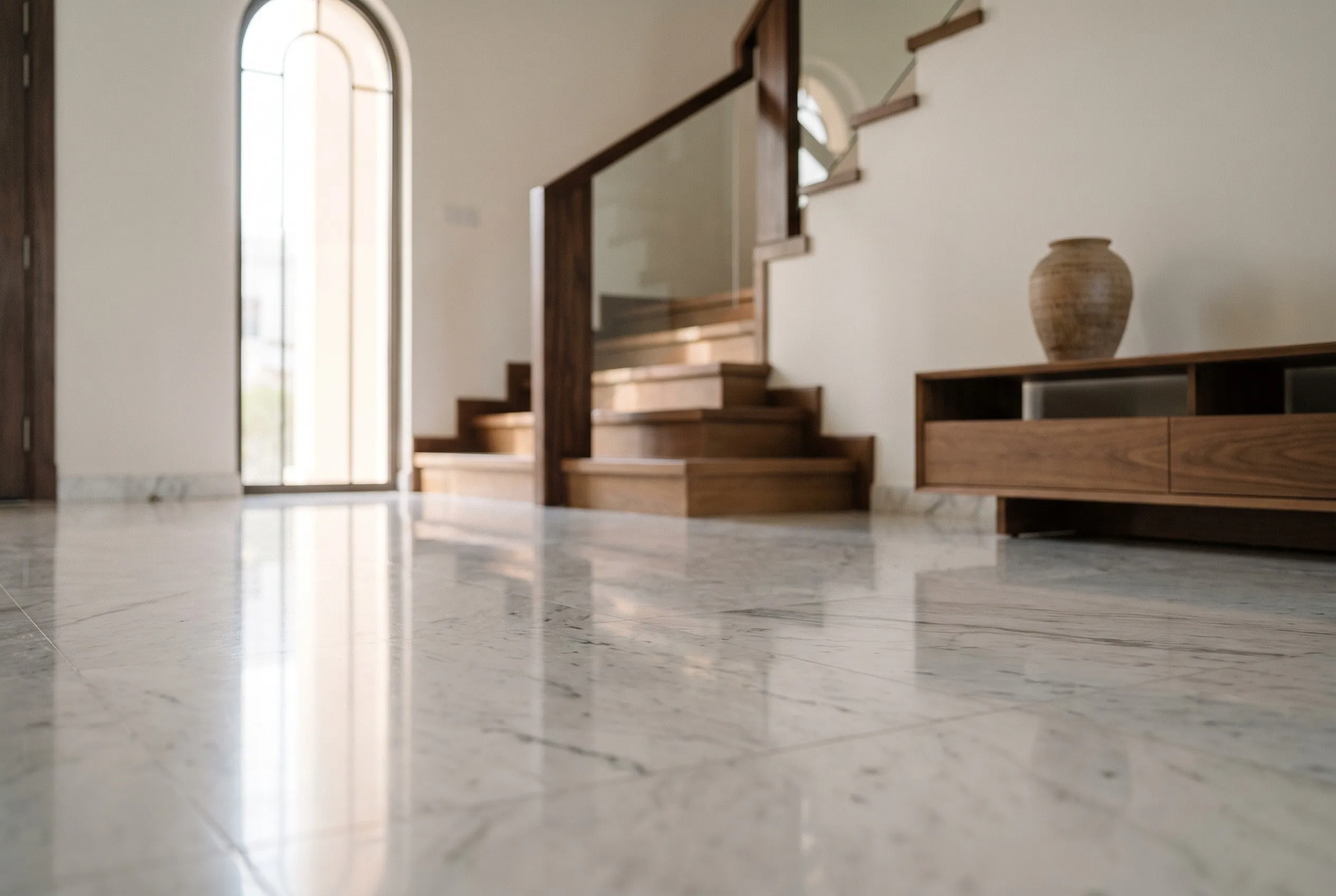
Marble is a good floor for Dubai living rooms, entrance halls and corridors. It is a poor choice for wet bathroom floors and for kitchens used every day, unless you accept regular upkeep. The stone copes well with heat and looks right in Dubai apartments and villas. Its weak points are staining, scratching, slipperiness when wet and a price that depends heavily on the slab and the installer.
Below we cover where marble pays off, what it costs, how to keep it looking good, and the checks we make before laying it.
Where marble works well and where it does not
Natural stone stays cool underfoot, which suits a climate where the AC runs for most of the year. It does not warp with humidity the way some wood floors can, and a good slab gives a depth of pattern that porcelain only imitates. In large open living areas in Dubai, a continuous marble floor with few joints makes a room look bigger and lighter.
The problems are practical. Marble is a soft, porous, calcium-based stone. Lemon juice, vinegar, some cleaning products and even red wine can etch or stain a polished surface. Dragged furniture leaves marks, and sand brought in from outside acts like sandpaper on a polished finish. In a villa with children and a garden entrance, that matters.
- Good fit: living and dining rooms, entrance halls, corridors, master bedrooms, low-traffic areas.
- Acceptable with care: kitchens, if sealed well and cleaned with stone-safe products.
- Poor fit: shower floors, wet rooms, balconies and terraces with polished finishes, which become slippery when wet. Use honed or textured stone, or porcelain, in those places.
What marble flooring costs in Dubai
Prices vary widely because the stone itself ranges from standard imported tiles to rare slabs. As a rough guide in 2026, typical ranges quoted in Dubai put marble flooring at about AED 300–700 per sq m, while basic installed tiling in ceramic or porcelain starts far lower. Some quotes for marble or terrazzo start above AED 220 per sq m for installed work, so a quote can land anywhere in or below that band depending on what it includes. Always ask whether a figure is material only or installed.
The final price depends on the stone type, thickness, tile or slab size, pattern matching, how level the existing screed is, and whether the edges and skirting are cut from the same stone. For comparison, engineered wood typically runs about AED 100–250 per sq m for material, and our guide to parquet and wooden flooring prices in Dubai covers that side. For the wider budget, see how much it costs to renovate an apartment in Dubai and our pricing page.
| Floor type | Typical range (AED per sq m, 2026) | What to know |
|---|---|---|
| Ceramic tile | 50–150 | Higher water absorption, about 3–7%; fine for dry rooms |
| Porcelain tile | 60–180 supply; labour from about 50 | Absorption about 0.5% or less; the usual choice for hot, humid climates |
| Engineered wood | 100–250 material | Needs a stable, dry substrate |
| Marble | 300–700 | Check if material only or installed |
Treat all of these as indicative. They mostly come from market guides, not fixed price lists, and your quote will reflect your floor area and layout.
Marble, porcelain or marble-look: choosing for your room
Many owners come to marble for the look, not the stone itself. Large-format marble-look porcelain gives a similar pattern with far less upkeep. It resists stains, does not need sealing and is usually cheaper to maintain. Real marble wins on authenticity and on the way it ages. If you are undecided, read our comparison of porcelain vs ceramic tiles in Dubai first.
Polished marble
The classic high-gloss look. Best in living rooms and halls. Shows scratches and etching most, so it needs regular care and occasional re-polishing.
Honed marble
A matte finish with better grip and less visible wear. A sensible choice for kitchens and busy family spaces.
Marble-look porcelain
Printed pattern on a dense body. Low maintenance, good in wet or high-traffic areas, and available in large formats.
Marble inlays and borders
Use real stone only where it is seen and rarely walked on, such as entrance medallions or feature strips, and keep porcelain for the rest.
Polishing, sealing and everyday care
Marble is not maintenance-free, but the routine is simple. Seal the stone after laying and re-seal on the schedule the sealer maker gives. Wipe spills quickly and clean with a pH-neutral stone cleaner, never acid-based bathroom products. Put mats at the entrance to stop sand and grit reaching the surface, and felt pads under furniture legs.
When a polished floor goes dull, a stone specialist can grind and re-polish it, usually in several passes with finer abrasives, then re-seal. Etching and light scratches often come out; deep chips and cracks need filling or tile replacement. Polishing makes dust and noise, so in an apartment it must follow building working hours and the rules in your NOC. We explain these in renovation working hours and building rules in Dubai. We do not publish a polishing price per sq ft; it depends on the condition of the floor, so we quote it after a survey.
The floor beneath the marble decides how long it lasts. Large stone tiles laid on an uneven or flexing screed crack and show lipped edges. Before any marble goes down, the base must be flat, dry and well supported, and any wet area must be waterproofed and tested first.
How we lay marble so it lasts
- Survey and moisture check We visit, measure the floor, check levels and the condition of the existing screed, and agree the stone, finish and budget with you.
- Building approval Flooring work usually needs the building's approval. We prepare and submit the documents for the NOC, so the schedule, noise hours and lift use are agreed before work starts.
- Base preparation The screed is levelled and flaws are corrected. Where the floor meets a wet area, waterproofing goes in and is flood-tested for 24 hours before any tile is laid.
- Layout and selection The tile layout is planned in advance, and slabs are laid out dry so the veining flows and shade differences are balanced.
- Laying to a laser level Tiles are set on a laser level with straight, even joints, which matters most with large formats.
- Sealing, protection and handover The stone is sealed, protected while other trades finish, cleaned and checked against a handover checklist, with a written warranty.
You see the progress through our daily photo and video report. If you live abroad, you can approve each stage by video call; see renovating your Dubai apartment while living abroad.
Questions to settle before you order stone
- Are you buying the exact slabs you saw, or a sample from a different batch? Natural stone varies between lots.
- Is the quoted price per sq m material only, or installed, with skirting, thresholds and cutting?
- Will the floor be honed or polished, and is the sealer specified?
- For a villa, does the master developer require approval for the work? Check with your building management or developer.
- Does your heavy stone floor suit the building's structure? Ask management if you are unsure.
These points also appear in common renovation mistakes in Dubai homes.
Choose real marble for dry, visible, low-to-medium-traffic areas such as living rooms and halls, and accept the care it needs. For bathrooms, balconies and heavy daily use, choose honed stone or marble-look porcelain. Whatever you choose, compare quotes on an installed basis and get the base prepared properly.
Not sure if marble suits your home?
We will visit, check your floor and base, show you options with visualisations of your own rooms, and give you an itemised quote with a fixed price and timeline.
Book a site surveyFAQ
Is marble a good floor for a Dubai villa?
Yes, for living areas, halls and bedrooms. It stays cool and suits Dubai's climate. Use honed stone or porcelain in wet or high-traffic areas, and plan for sealing and occasional re-polishing.
How much does marble flooring cost in Dubai?
As a rough guide in 2026, typical ranges quoted are about AED 300–700 per sq m, though some installed quotes start lower. The price depends on stone, thickness, tile size, base preparation and whether it is material only or installed.
Can marble floors be re-polished?
Often yes. A specialist grinds and polishes the surface in stages and re-seals it, which removes light scratches and dullness. Deep chips or cracks need repair or replacement of the tile, and the work must follow your building's working hours.
Is marble slippery in a bathroom?
Polished marble can be slippery when wet, so we do not recommend it on shower or wet-room floors. Honed or textured stone, or non-slip porcelain, is safer, and the floor must be waterproofed and flood-tested before tiling.