Villa Renovation on Palm Jumeirah: Rules and Finishes
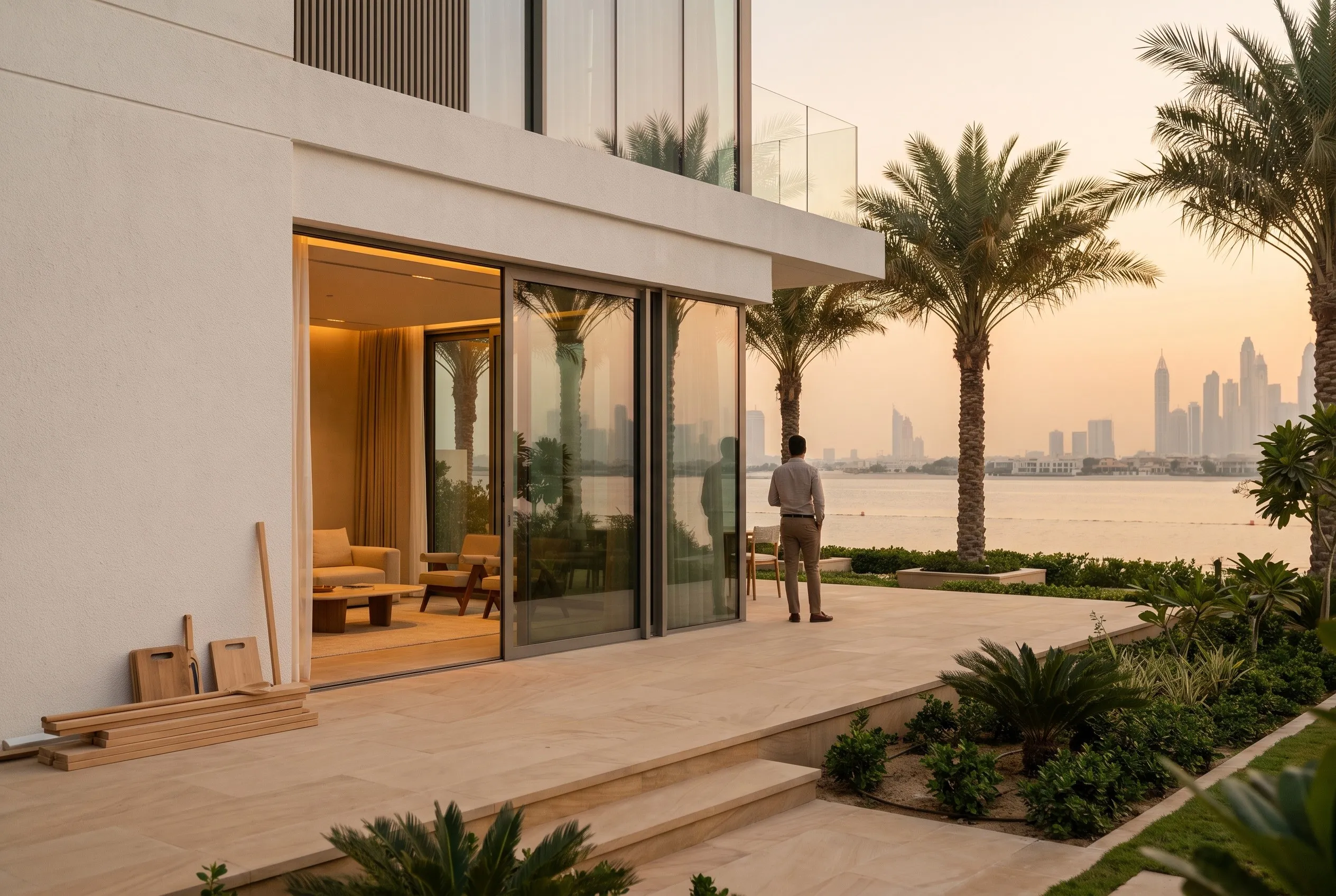
A villa on Palm Jumeirah is renovated like any large Dubai villa, with three differences. The master developer's approval comes first. The sea air is hard on metal, wood and cheap finishes. And the plot is tight, with a shared frond, a beach and neighbours close by, which affects deliveries and noise. Plan around these three and the project is predictable.
Below is what we check on every Palm villa: approvals, materials for salt and humidity, the typical upgrades, budgets and the order of work.
Approvals on Palm Jumeirah come before drawings
Palm Jumeirah was developed by Nakheel, and villa alterations there depend on developer approval. Published guidance says approval is needed for extra bedrooms, kitchen or living-room expansions, first-floor additions, pools, pergolas and garage changes. An older press report went further and said that all modifications need developer approval before construction. Treat the stricter reading as the safe one. Owners with unpaid service charges have also been reported as blocked from modifying, so settle any balance first.
The same old report cited fines of around AED 10,000 plus payment for added space on another Nakheel community. Those figures are old, but they show the direction: unapproved work is expensive to regularise. Separately, Dubai-wide, unapproved work can mean fines, stop-work orders and forced reinstatement.
Which authority issues the permit for a given plot, and which documents it needs, should be confirmed with Nakheel before design starts. Third-party guides place Palm Jumeirah under Trakhees, which reviews modification drawings and issues a completion certificate. Others describe the Dubai Municipality route. Do not rely on either: ask in writing, and design to what you are told. For the general logic of NOCs, see our guide to renovation permits. For structural work, see building permits for villas.
Cosmetic work is not the same as an approved scope. Repainting and loose furniture usually need no permit. Moving walls, reconfiguring bathrooms, new electrical or AC work and anything visible from outside do. Confirm each item before ordering materials, not after.
Nakheel's Palm rules that change the design
Some restrictions are written for the Palm specifically. Fencing on frond villas must be light-weight with at least 60% transparency, so solid walls or heavy screens facing the frond are out. Still water bodies are not permitted, which affects ponds and some decorative pool features. Check any exterior plan against the current community rules, and look at neighbours' approved work only as a hint, not as proof of what you can build.
We prepare and submit the documents for the NOC and, where needed, authority approvals. You sign as the owner, and the drawings go in only when they match what will be built. Changes made on site afterwards risk a mismatch with the approved plans.
Salt air, humidity and what to specify
On the Palm, salt and humidity reach almost every surface. That is general building physics, not a Palm-only rule, but it is stronger here than inland. Specify with that in mind:
- Floors. Porcelain absorbs about 0.5% water or less, while ceramic is typically around 3–7%. Porcelain is the usual choice in hot, humid climates. Compare options in porcelain vs ceramic tiles. Natural stone and wood need sealing and a maintenance plan; see marble flooring and real wood vs wood-look porcelain.
- Metalwork. Choose hardware, taps, door furniture and exterior fixings rated for coastal use, and ask for the finish specification in writing. Cheap plating is where salt shows first.
- Joinery. Bespoke built-ins are made in Dubai to our drawings. Moisture-resistant boards and sealed edges matter most near terraces and sliding doors.
- Wet areas. Waterproofing is not where to save. We flood-test for 24 hours before any tile goes down. See waterproofing methods compared.
- Roof and terraces. Exposed roofs take the full sun and sea wind. Read villa roof waterproofing before closing a quote.
- AC. Humidity makes ventilation and condensation control part of the design, not an afterthought. See AC and ventilation during renovation.
What Palm villa owners usually change
Frond and signature villas vary a lot in layout, so a fixed list is not possible. The recurring requests are these, with the Palm angle for each:
| Upgrade | Palm-specific point | What to do |
|---|---|---|
| Kitchen | Large, often open to living areas, with sea-facing glazing | Settle plumbing and extraction first; cabinets made to measure |
| Bathrooms | Several wet rooms; humidity stays high | Full waterproofing and flood test in every room |
| Flooring | Sand and salt tracked in from beach and pool | Porcelain or sealed stone; avoid soft finishes at entrances |
| Terrace and outdoor area | Pergolas and pools need developer approval | Get the NOC before ordering anything |
| Fencing and boundary | Frond villas: at least 60% transparency | Design to the rule, not to a neighbour's look |
| Lighting | Exterior lighting restrictions exist in some master communities | Check the rules before specifying exterior fittings |
| Layout changes | Extra rooms and extensions need approval | Include in the NOC application; see villa extensions |
For interior direction, villa interior design ideas and our interior design service show how layouts, working drawings and photorealistic visualisation of each room are prepared. We can also visualise on photos of your own rooms, so you see the result before work starts.
Budget and timeline for a Palm villa
As a rough guide in 2026, typical ranges quoted in Dubai for villa renovation are about AED 120–250 per sq ft for basic work, 250–450 mid-range and 450+ luxury. Whole-project totals are typically quoted around AED 200,000–350,000 for basic, 400,000–800,000 for mid-range and over AED 1 million for luxury. Per-sq-ft pricing is unreliable when kitchens, bathrooms and joinery dominate, which is common on the Palm. These are market ranges, not our prices. See villa renovation cost in Dubai for what moves the number.
For duration, typical figures are 12–18 weeks for a partial 4-bedroom villa and 18–30 weeks for a complete 5–6 bedroom one. Imported materials can take 6–12 weeks to ship, and permits can add time, so a buffer of 1–2 weeks is sensible. The exact programme for your villa is fixed in the contract after the survey. More in full villa renovation stages.
How the work goes
- Survey and brief. We visit, measure, photograph, and discuss your brief and budget.
- Design and quote. Layout, working drawings and visualisation, then an itemised quote. The price and timeline are fixed in the contract, with no extras beyond the quote.
- Approvals. We prepare and submit the NOC documents and any authority approvals. Work starts only after they are in hand.
- Strip-out and hidden works. Demolition, plumbing and electrics. Pipes, cables and waterproofing are photographed before they are covered.
- Wet areas and finishes. Waterproofing and a 24-hour flood test, then tiles planned in advance and laid to a laser level. Joinery follows.
- Handover. Checklist, cleaning and a written warranty. A daily photo and video report runs through all stages, and clients abroad can accept each stage by video call.
One person is in charge from the first survey to handover. Furniture, lifts and corridors are protected and the site is kept clean, which matters when neighbours are close.
On Palm Jumeirah, secure Nakheel's approval in writing first, then design for salt and humidity: porcelain or sealed stone, coastal-grade metalwork, full waterproofing. Book a survey, and you will get an itemised quote with a fixed price and timeline.
Planning a Palm Jumeirah villa renovation?
We survey the villa, check what needs approval and give you an itemised quote. See also our projects.
Discuss your villaFAQ
Do I need approval to renovate a villa on Palm Jumeirah?
Yes for anything beyond cosmetic work. Nakheel guidance lists extra rooms, kitchen or living-room expansions, pools, pergolas and garage changes as needing approval, and an older report says all modifications do. Ask Nakheel in writing which items in your scope need a NOC.
Are there fence rules on Palm frond villas?
Yes. Fencing on frond villas must be light-weight with at least 60% transparency. Still water bodies are also not permitted. Check the current rules with Nakheel before you design boundary or garden work.
Which flooring suits a Palm Jumeirah villa?
Porcelain is the usual choice in hot, humid conditions because it absorbs about 0.5% water or less. Natural stone and wood can work but need sealing and ongoing care. Entrances take the most sand and salt, so choose hard-wearing finishes there.
How long does a Palm villa renovation take?
As a rough guide, typical figures are 12–18 weeks for a partial 4-bedroom villa and 18–30 weeks for a complete 5–6 bedroom one. Imported materials and permits can add time. We fix the timeline in the contract after the survey.